Growth changes how a transport business needs to operate.
A small team can often manage jobs through phone calls, messages, and a few spreadsheets. Drivers know which vehicles they normally use. Payment records are checked manually. If something changes, someone makes a call.
That approach becomes harder to maintain as booking volume increases.
More drivers mean more availability to check. More vehicles mean more records, assignments, and maintenance requirements. More jobs mean more payments to collect, reconcile, and distribute.
The problem is not that the business has grown.
The problem is that drivers, vehicles, bookings, and payments are often still managed as separate tasks.
Larger transport operators need one operating process that connects them.
Why growth creates more operational pressure
Every booking affects several parts of the business.
Before the trip begins, the operator needs to know:
- Which driver is available
- Which vehicle is suitable
- Whether both are approved and ready
- What the client has requested
- How the booking will be priced
- Who needs to be paid after the trip
During the job, the team may also need to monitor timing, changes, driver activity, and client updates.
After the job, the operator must confirm completion, collect payment, calculate driver earnings, update records, and prepare reporting.
When each step lives in a different system, the team has to join the information together manually.
That is where delays, missed details, duplicated work, and payment errors begin.
RideMinder brings bookings, drivers, vehicles, payments, and reporting into one platform, giving operators a clearer view across the day-to-day operation. Explore the full RideMinder feature set.
1. Manage drivers around real availability
Driver management is more than keeping a list of names and phone numbers.
As an operation grows, dispatch teams need to understand:
- Who is available
- Where each driver is
- What work they are already assigned
- Which vehicles they can operate
- Whether their records are current
- How they have performed on previous jobs
- Which clients or services they are best suited to
Without that visibility, assignment becomes reactive.
Dispatchers call several people, wait for replies, and manually compare schedules before the job can move forward.
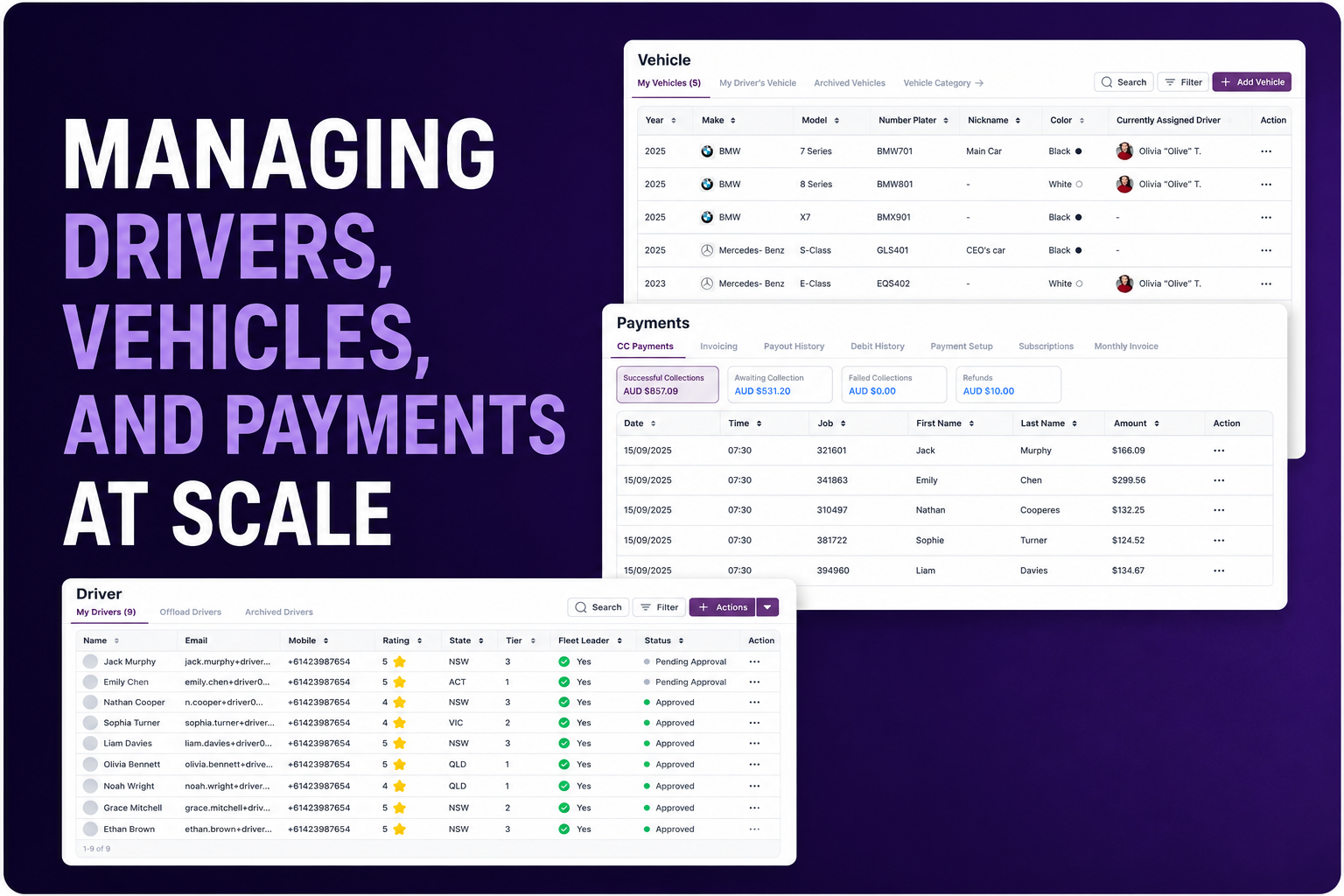
RideMinder’s Driver Manager is designed to centralise driver information, availability, job allocation, tracking, and performance records. It also supports job distribution based on factors such as location, schedule, and availability.
That does not remove the dispatcher’s judgement.
It gives them better information before they make the decision.
Keep driver communication tied to the booking
A driver should not need to search through multiple messages to understand a job.
The latest pickup time, passenger details, route, vehicle assignment, booking notes, and changes should all stay connected to the trip.
This reduces repeated calls and helps the driver work from the same information as the operations team.
When the booking changes, the driver needs the updated information quickly. When the driver completes an action, the operator needs to see it without waiting for another phone call.
That connection becomes especially important when dozens of drivers and jobs are active at the same time.
2. Treat vehicles as active operational records
Vehicle management becomes difficult when information is stored across spreadsheets, folders, inboxes, and individual staff members.
For each vehicle, the operator may need to track:
- Registration details
- Insurance and verification records
- Capacity
- Vehicle category
- Service suitability
- Assigned drivers
- Availability
- Operational status
- Maintenance requirements
The vehicle is not simply an asset in a list.
It determines whether a job can be completed correctly.
An airport transfer with multiple passengers and luggage may require a different vehicle from an executive sedan booking. A corporate account may have specific vehicle standards. A driver may only be approved for certain categories.
RideMinder’s Vehicle Manager helps operators maintain vehicle records and keep each vehicle ready for work.
Connect the driver, vehicle, and booking
A common operational problem is treating these as three separate decisions.
The job is booked first.
The driver is assigned later.
The vehicle is checked after that.
When the information is disconnected, teams can assign an available driver without confirming that the right vehicle is also available.
A stronger workflow connects all three.
The operator sees the booking requirements, selects an appropriate driver, confirms the vehicle, and keeps those assignments attached to the job.
That creates a clearer record of:
- Who completed the trip
- Which vehicle was used
- What the client requested
- What the driver should be paid
- What the client should be charged
This record becomes the foundation for reporting and financial control later.
3. Keep every booking visible to the team
As booking volume grows, operations teams cannot rely on memory.
They need to see which jobs are:
- Pending
- Confirmed
- Assigned
- In progress
- Completed
- Cancelled
- Waiting for action
RideMinder’s Booking Manager provides job status visibility, dispatch support, trip monitoring, direct bookings, and alerts for issues such as missed assignments or scheduling conflicts.
This helps the team focus on the bookings that need attention.
Instead of checking every job manually, dispatchers can look for exceptions:
- A driver has not been assigned
- A vehicle is missing
- A trip may be delayed
- A job has conflicting details
- A booking has changed
- A completed trip has not moved into the payment process
That shift matters at scale.
The goal is not to watch every movement.
It is to know when normal operations have stopped progressing as expected.
4. Connect completed trips to client payments
Finishing the trip should move the booking into the next stage automatically.
In many transport businesses, it does not.
The operations team marks the job complete. Finance receives a spreadsheet later. Someone checks the fare, adds any approved charges, prepares an invoice, and follows up with the client.
The larger the operation becomes, the more difficult that process is to reconcile.
RideMinder’s Payment Manager connects payment collection, invoicing, payment status, completed jobs, and operator payout records in one workflow.
This gives the team a clearer answer to several important questions:
- Has the client been charged?
- Is the payment still awaiting collection?
- Has the invoice been issued?
- Has the driver payment been calculated?
- Is a refund required?
- Which transactions still need attention?
When that information is visible, the finance team spends less time rebuilding the story behind each payment.
5. Standardise driver and supplier payments
Paying drivers becomes more complicated as the business adds:
- Different driver agreements
- Percentage-based payments
- Fixed job rates
- Vehicle payments
- Supplier arrangements
- Account-specific pricing
- Additional approved charges
Manual calculations increase the risk of inconsistency.
Two similar jobs may be handled differently depending on who prepares the payment. Records may not show clearly why a particular amount was paid. Disputes become harder to resolve because the original booking details sit somewhere else.
The better approach is to keep the payment rules connected to the booking.
When the trip is completed, the platform should already know:
- The agreed client price
- The assigned driver
- The vehicle used
- The driver or supplier terms
- Any approved additional charges
- The final amount due
This gives the operator a clearer audit trail and helps drivers understand how their payment was calculated.
6. Give finance and operations the same information
Operations and finance often work from different views of the same business.
Operations sees bookings, drivers, and vehicles.
Finance sees invoices, payments, payouts, and revenue.
When those records do not match, both teams lose time.
Operations may need to explain why a fare changed. Finance may need to confirm whether a trip was completed. A driver may question a payment. A client may ask for a corrected invoice.
Connected systems reduce that back-and-forth.
RideMinder’s Automated Invoicing supports scheduled invoice generation, multiple payment methods, and reporting from the same operational data.
The benefit is not simply faster invoicing.
It is a cleaner handover from the completed job to the financial record.
7. Use reporting to find where work is getting stuck
Reporting should help an operator make decisions.
It should not simply produce a larger spreadsheet.
At scale, useful reporting can help answer:
- Which drivers complete the most work?
- Where are jobs being delayed?
- Which vehicles are underused?
- Which clients generate the most revenue?
- How much money is awaiting collection?
- Which routes or services perform best?
- How much work is being offloaded?
- Where is additional capacity required?
RideMinder includes trip reporting and enhanced reporting tools across its broader feature and plan structure.
Fleet operators can review performance across drivers, routes, and time, while Enterprise operators can gain visibility across regions, contracts, and larger operational structures.
The aim is not to report on everything.
It is to identify what the team needs to change.
8. Separate access based on responsibility
As more people join the business, not everyone should have the same access.
A driver may need trip information but not client pricing.
A dispatcher may need to assign jobs but not edit financial settings.
Finance may need payment and invoice records but not dispatch controls.
Management may need reporting across the entire operation.
RideMinder’s Admin Settings support user access controls, business rules, pricing settings, and operational permissions.
Clear permissions help protect sensitive information and make responsibility easier to understand.
People can focus on the part of the operation they are responsible for without changing information outside their role.
9. Build processes that work without constant supervision
The real test of an operation is not whether it works when the owner is watching.
It is whether the team can keep jobs moving when the owner is unavailable.
That requires:
- Clear booking statuses
- Defined assignment rules
- Current driver and vehicle records
- Consistent payment rules
- Alerts for exceptions
- Role-based access
- Shared reporting
Large operators do not remove people from the process.
They remove the need for people to remember every step.
The system holds the workflow.
The team handles decisions, service issues, client relationships, and exceptions.
What managing at scale should look like
A growing transport operation should be able to answer these questions quickly:
- Which jobs still need a driver?
- Which vehicles are available?
- Is every assigned driver ready to work?
- Which trips are currently active?
- Has each completed job been charged?
- What does each driver need to be paid?
- Which clients or accounts require follow-up?
- Where is the operation beginning to fall behind?
When those answers require several phone calls or spreadsheets, the business is carrying unnecessary operational risk.
When the answers are available in one connected view, the team can act earlier and with more confidence.
Manage more work without creating more manual work
Growth should not force the business to choose between taking on more jobs and maintaining control.
Drivers, vehicles, bookings, and payments should work as one operational flow.
RideMinder helps Fleet and Enterprise operators connect those areas, reduce repeated admin, and maintain a clearer view across the business.
Its Fleet solution supports dispatch, driver and vehicle management, reporting, payments, and invoicing, while its Enterprise offering adds deeper visibility and controls for larger or multi-region operations.
Connect your operation in one platform
Explore the RideMinder setup designed for growing fleets and larger transport businesses.