Managing one driver is straightforward.
Managing five, twenty, or one hundred drivers is a different type of operation.
As more people become involved, information has to move between dispatchers, drivers, account managers, suppliers, finance teams, and clients. A booking change that once required one phone call can quickly become a chain of messages, updates, and follow-ups.
The challenge is not simply having more drivers.
It is making sure every person has the right information, every job has a clear owner, and the operator can see what is happening across the business.
Large transport operators manage this by building consistent workflows around six areas:
- Booking visibility
- Driver allocation
- Communication
- Service monitoring
- Payments and reporting
- External capacity
Here is what that looks like in practice.
1. Keep every booking in one operating view
Multi-driver operations become difficult when bookings are scattered across emails, spreadsheets, messaging apps, and separate client systems.
Dispatchers then spend time checking:
- Which jobs are confirmed
- Which drivers have been assigned
- Whether a change has been acknowledged
- Which trips are currently in progress
- Which bookings still need attention
- Whether the client has been updated
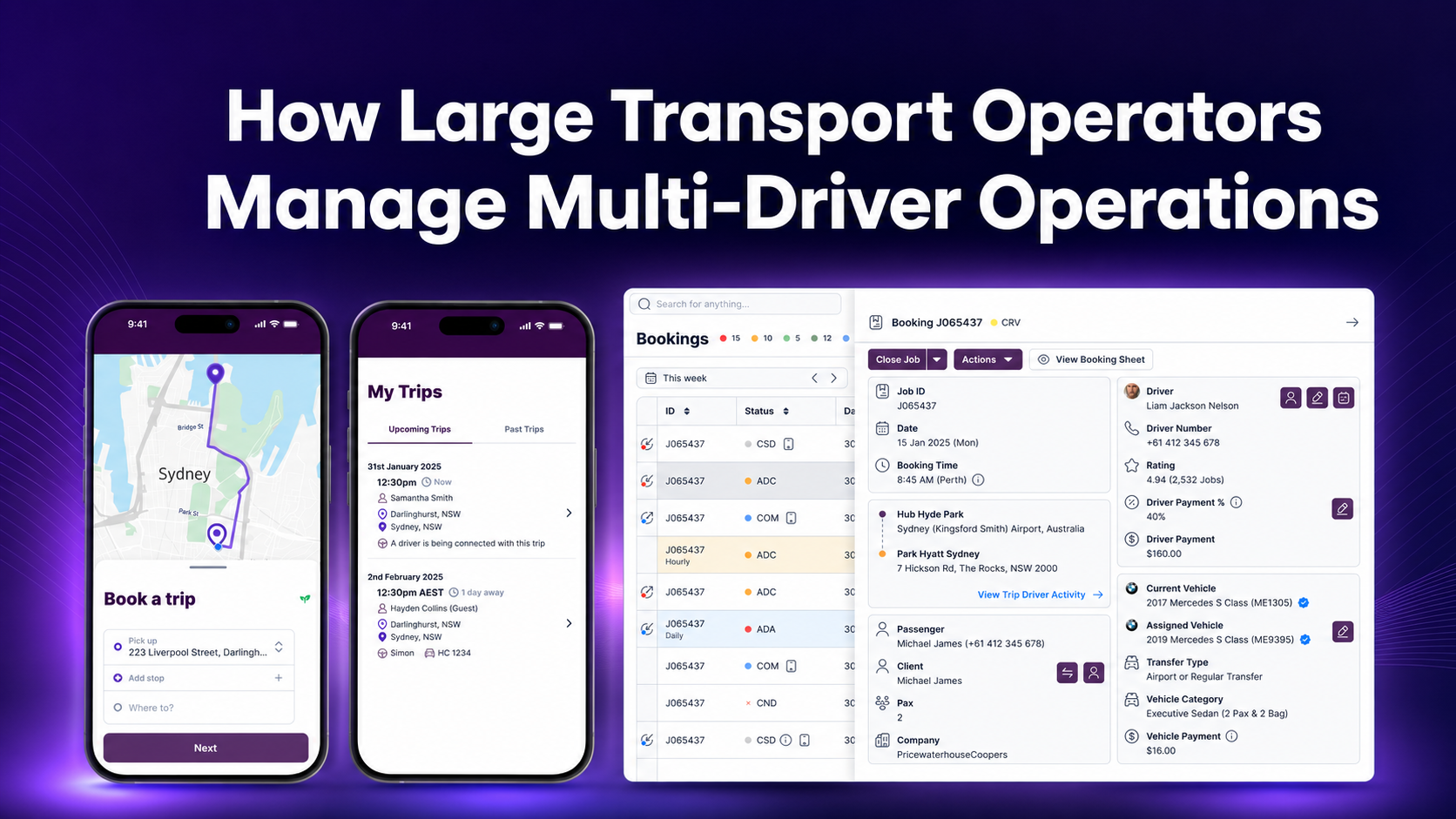
Large operators need a shared booking view that shows the status of each job from confirmation through to completion.
RideMinder’s Booking Manager gives operators visibility over pending, assigned, active, and completed bookings. It also helps teams identify scheduling conflicts, missed assignments, and jobs that require attention before they become larger service problems.
This reduces the need for dispatchers to reconstruct the day from messages and phone calls.
The operational question changes from:
Does anyone know what is happening with this job?
to:
What needs our attention next?
That is an important difference when hundreds of bookings may be moving through the business.
2. Assign drivers using clear rules
Driver allocation should not depend entirely on who happens to answer the phone first.
Large operators usually consider several factors before assigning a job:
- Driver availability
- Location
- Vehicle suitability
- Existing schedules
- Client requirements
- Service level
- Pricing arrangements
- Driver performance
- Contract or account rules
Without a consistent allocation process, the same problems appear repeatedly: double bookings, unnecessary dead kilometres, unsuitable vehicles, missed instructions, and uneven workloads.
A Driver Manager gives operators one place to manage driver availability, performance, and operational information.
The goal is not to remove human judgement.
It is to give dispatchers better information so they can make decisions quickly and consistently.
3. Give drivers one reliable source of information
Drivers should not have to search through text messages to find the latest pickup time, passenger name, destination, flight number, or special instruction.
Every additional communication channel creates another place where information can be missed.
Well-run multi-driver operations give drivers a clear view of:
- Assigned jobs
- Pickup and destination details
- Passenger information
- Timing and status updates
- Vehicle requirements
- Booking notes
- Changes made by dispatch
- Actions required during the trip
RideMinder connects dispatch and driver workflows through its booking platform and Driver App. This keeps drivers, bookings, trip updates, and client information connected rather than spread across separate systems.
This matters because the driver is often the last person in the service chain before the passenger.
When drivers receive incomplete or outdated information, the client experiences the result.
4. Monitor exceptions, not every movement
A large operation cannot rely on dispatchers manually checking every driver throughout the day.
That does not scale.
Instead, the team needs to identify jobs that fall outside the expected workflow:
- A driver has not acknowledged a booking
- A vehicle has not been assigned
- A pickup time has changed
- A trip may be running late
- A driver is unavailable
- A booking contains conflicting information
- A client instruction has not been completed
RideMinder’s Booking Manager helps operators focus on bookings that need intervention rather than repeatedly checking jobs that are progressing normally.
This is how larger teams avoid becoming buried in routine follow-ups.
The system supports visibility.
The operations team handles judgement, exceptions, and client care.
5. Maintain consistent service standards
When one person completes every job, service quality is largely controlled by that individual.
In a multi-driver business, the operator has to create consistency across the whole team.
That includes:
- Arrival standards
- Vehicle presentation
- Passenger communication
- Driver behaviour
- Booking notes
- Incident handling
- Ratings and feedback
- Account-specific requirements
Large operators cannot assume every driver will interpret instructions in the same way.
Standards need to be documented, communicated, measured, and reinforced.
RideMinder’s Driver Manager and Vehicle Manager help operators maintain clearer records across driver information, vehicles, verification, and trip performance.
This gives the operator a clearer basis for coaching, preferred-driver decisions, and service improvement.
The purpose is not to monitor drivers for the sake of monitoring them.
It is to protect the client experience across every job.
6. Connect jobs to payments and reporting
In a multi-driver operation, completing the trip is only part of the workflow.
The booking may also affect:
- Client billing
- Driver payments
- Operator revenue
- Additional charges
- Corporate account reporting
- Supplier payments
- Refunds
- Payment collection
- Reconciliation
When these processes sit in separate spreadsheets, finance teams have to manually match trips, drivers, clients, and payment records.
RideMinder’s Payment Manager connects completed jobs with payment status, invoicing, and operator records.
For large operators, this provides more than administrative convenience.
It creates a clearer record of what happened, who completed the work, what the client was charged, and what still requires action.
Enterprise operators may also need reporting across contracts, regions, teams, or company accounts. RideMinder’s Enterprise Operator solution is designed for larger businesses that need stronger reporting, supplier management, integrations, and standardisation across complex operations.
7. Separate access by role
Not every team member needs access to every part of the operation.
Drivers, dispatchers, finance staff, managers, and external suppliers have different responsibilities.
Clear access controls help operators decide who can:
- View bookings
- Edit job details
- See client pricing
- Assign drivers
- Access financial records
- Change business rules
- Manage accounts
- Review reporting
RideMinder’s Business Rules help operators configure permissions, pricing, dispatch, and operational settings around the way their business works.
This becomes increasingly important as the operation grows across multiple offices, regions, or departments.
Access should support accountability, not create another source of confusion.
8. Plan for demand beyond the internal fleet
Even a large fleet has limits.
Demand can exceed capacity during major events, flight disruptions, seasonal peaks, vehicle downtime, or overlapping corporate bookings.
The strongest operators do not wait until every internal driver is unavailable before deciding what to do.
They build trusted external capacity in advance.
RideMinder’s RM Network helps operators work with trusted transport partners while retaining control over how jobs are distributed.
Operators can organise partners into tiers and apply dispatch settings based on their preferred network structure.
A structured supplier network is not just a backup list.
It is part of capacity planning.
It helps the operator accept more work without lowering standards or relying on rushed, unfamiliar arrangements.
What successful multi-driver operations have in common
Large transport operations may serve different clients, regions, and transport categories, but the strongest ones tend to follow the same operating principles.
They make ownership clear.
They keep booking information in one place.
They give drivers accurate, current instructions.
They use alerts to identify exceptions.
They connect completed trips to payments and reporting.
They apply consistent rules across staff, drivers, and suppliers.
Most importantly, they do not try to manage growth through more phone calls, more spreadsheets, and more individual effort.
They build a system that lets the team see what is happening and act when something needs attention.
Manage more drivers without creating more admin
Multi-driver operations do not become manageable simply by hiring more dispatchers.
They become manageable when the work is organised clearly across bookings, drivers, payments, communication, and reporting.
RideMinder brings those workflows into one platform for growing fleets and enterprise transport businesses. Operators can manage daily jobs, monitor driver activity, connect payment workflows, work with trusted partners, and maintain a clearer view across the operation.
Find the right RideMinder setup for your operation
Explore the tools available for growing fleets and larger transport businesses.